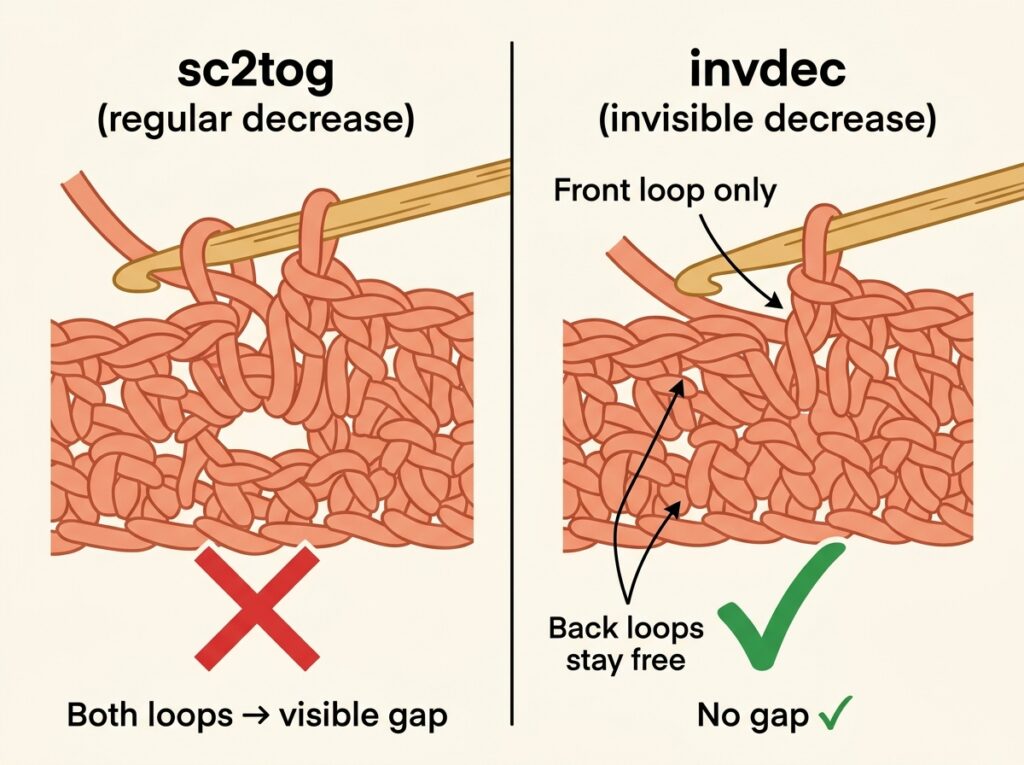
If you’ve seen FLO or BLO in a crochet pattern and weren’t sure what to do, this quick guide will clear it up completely. These two abbreviations — Front Loop Only and Back Loop Only — unlock an enormous range of textures, structural joins, and clean construction techniques that are used constantly in amigurumi, granny squares, and beyond.
Understanding the Two Loops of a Crochet Stitch
Look at the top of any completed crochet stitch. You’ll see a small V-shape made of two loops:
- Front loop (FL): the loop closest to you as you hold the work normally
- Back loop (BL): the loop furthest from you, on the other side of the V
Normally, every stitch goes under both loops. When a pattern says FLO or BLO, you insert your hook under only one of those loops and ignore the other.
What Does FLO Do?
Working into the front loop only leaves the back loop free. That free back loop creates a visible ridge or ledge on the back of your work — which can be the front of a finished piece, depending on orientation. It also creates a structurally useful attachment point.
Common FLO uses:
- Attaching tentacles, arms, or ears to amigurumi (the back loop becomes the joining ridge)
- Creating ribbing texture on hat brims and cuffs
- The Moss stitch (alternating FLO sc with chains)
- Sock toes and heels in seamless construction
What Does BLO Do?
Working into the back loop only leaves the front loop free, creating a ridge on the front of the work. This ridge runs horizontally across the fabric and gives a knit-like ribbed texture when worked consistently across rows or rounds.
Common BLO uses:
- Ribbing on hat brims, bag straps, and cuffs
- Basket weave textures
- Granny square borders where you want a clean raised edge
- Waistbands and stretchy joins
How to Work FLO — Step by Step
Step 1: Find the Front Loop
Hold your work with the right side (smooth side) facing you. The front loop is the loop of the V-stitch closest to you. Tilt the work slightly if needed — it becomes obvious once you know which side you’re looking at.
Step 2: Insert Hook Under Front Loop Only
Slide your hook under only the front strand of the V. The back loop should still be sitting untouched behind it. If your hook catches both strands, pull back and try again.
Step 3: Complete Your Stitch as Normal
Yarn over, pull through, yarn over, pull through remaining loops — exactly like a regular single crochet. The back loop stays free.
FLO in Action: No-Sew Octopus Tentacles
In Clara’s Free No-Sew Mini Octopus Pattern, Round 8 is worked entirely in FLO. After 7 rounds of building the head, the hook works into the front loops at the open base of the head — and each group of 3 front loops becomes the base for one tentacle. The untouched back loops stay behind and close the base later in Round 9. This is how the octopus achieves its seamless, no-sew construction: the tentacles are part of the head, not attached separately.
Abbreviations You’ll See
- FLO — Front Loop Only
- BLO — Back Loop Only
- FL — Front Loop
- BL — Back Loop
- FP — Front Post (different technique — wraps around the post of the stitch, not the loops at the top)
- BP — Back Post (same note — not the same as BLO)
Common Mistakes
- Confusing FP/BP with FLO/BLO: Front post and back post go around the stitch column below; FLO/BLO go under loops at the top. Different results entirely.
- Losing track of which is front: if you flip your work between rows, the front loop flips too. Mark the RS of your work with a stitch marker.
- Loose tension: FLO and BLO stitches are slightly looser than regular stitches. Tension down slightly to compensate.
FAQ
Does working FLO change my stitch count?
No — FLO and BLO are modifications to where you insert the hook, not changes to the stitch type. One FLO sc still counts as 1 sc.
What happens to the unused loop?
It stays there, creating a ridge or a live loop depending on the pattern. In some constructions, the pattern will come back to it in a later round (as in the octopus, where the back loops of Round 7 are used again in Rounds 9–11 to close the base).
Can I use FLO with any crochet stitch?
Yes — FLO and BLO work with sc, hdc, dc, and most other stitches. The instruction will usually specify: hdc BLO or dc FLO to make it clear which stitch and which loop.
Related Techniques
These techniques are used together in amigurumi construction:
- Magic Ring — start every amigurumi round with zero gap in the center
- Invisible Decrease (invdec) — decrease rounds without visible holes or gaps